So far, my astronomical observations had always been limited to the night. For quite some time, however, I had been thinking about getting an H-alpha telescope that would make it possible to observe the Sun – during the day, of course. An H-alpha telescope uses a special filter, a Fabry-Pérot etalon, to let through the Sun’s hydrogen emission at an extremely narrow bandwidth. The wavelength the etalon is calibrated to is the hydrogen-alpha line, hence the name of the telescope. Of course, one could also observe the Sun in white light (and much more cheaply, using a solar filter and a regular refractor telescope). But this only allows you to observe sunspots, and those can get old rather quickly. According to the literature, the Sun can also become extremely unspectacular in white light during the minimum of the solar cycle – so it is not exactly ideal for outreach events  .
.
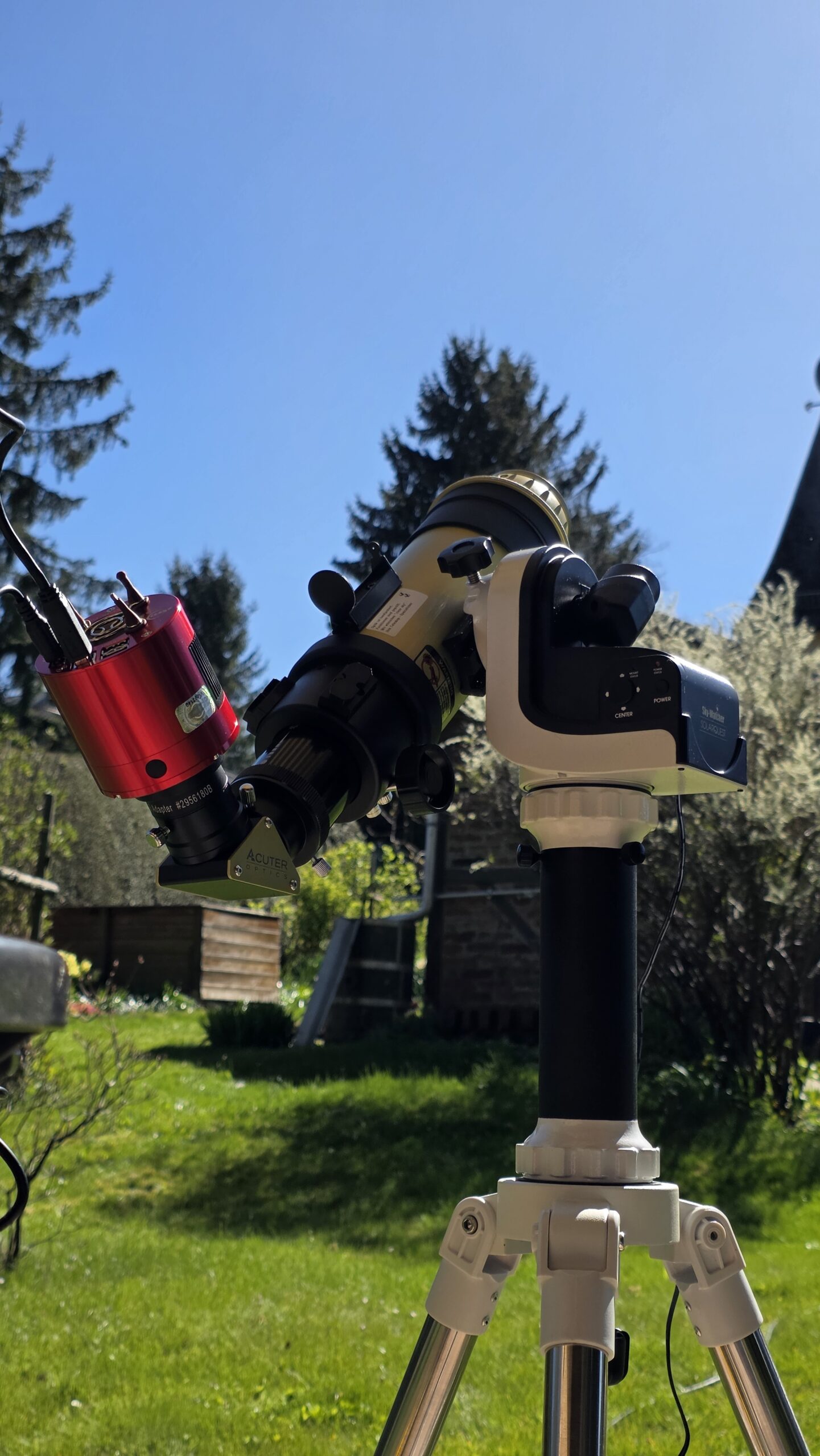
The Acuter 40/400 on the SolarQuest, with ZWO ASI533 and Baader Hyperion Barlow 2.25x
In the end, I decided on an Acuter 40/400. I had been keeping an eye on the Acuter since its release about a year ago, hoping to eventually find a bargain. But telescopes are apparently like musical instruments – extremely price-stable until the product is discontinued. So before summer would really get going, I finally went for it. I also added the SkyWatcher SolarQuest solar mount, which makes it possible to find and track the Sun fully automatically. This should allow observations lasting several hours.
At first I still had a camera in my shopping cart, but then decided to simply try it with my existing ZWO ASI533. I also attached my Baader Hyperion 2.25x Barlow to it. And what can I say? I am really impressed by the images. The imaging performance through the included zoom eyepiece, even though it is rather simply made, is unexpectedly good. Only the apparent field of view narrows quite noticeably as the eyepiece focal length decreases (that is, as magnification increases). Photographically, there is nothing to complain about either. While many H-alpha telescopes have a sweet spot, meaning an image area where the filter works best, I think the filter behavior of the Acuter is homogeneous enough. At least with the ASI533 + 2.25x Barlow, I could not find anything to suggest otherwise. So here is my first solar photo, captured within 5 minutes, debayered with PIPP, stacked with AutoStakkert 4 (best 25 %) and processed with PixInsight and ImPPG:
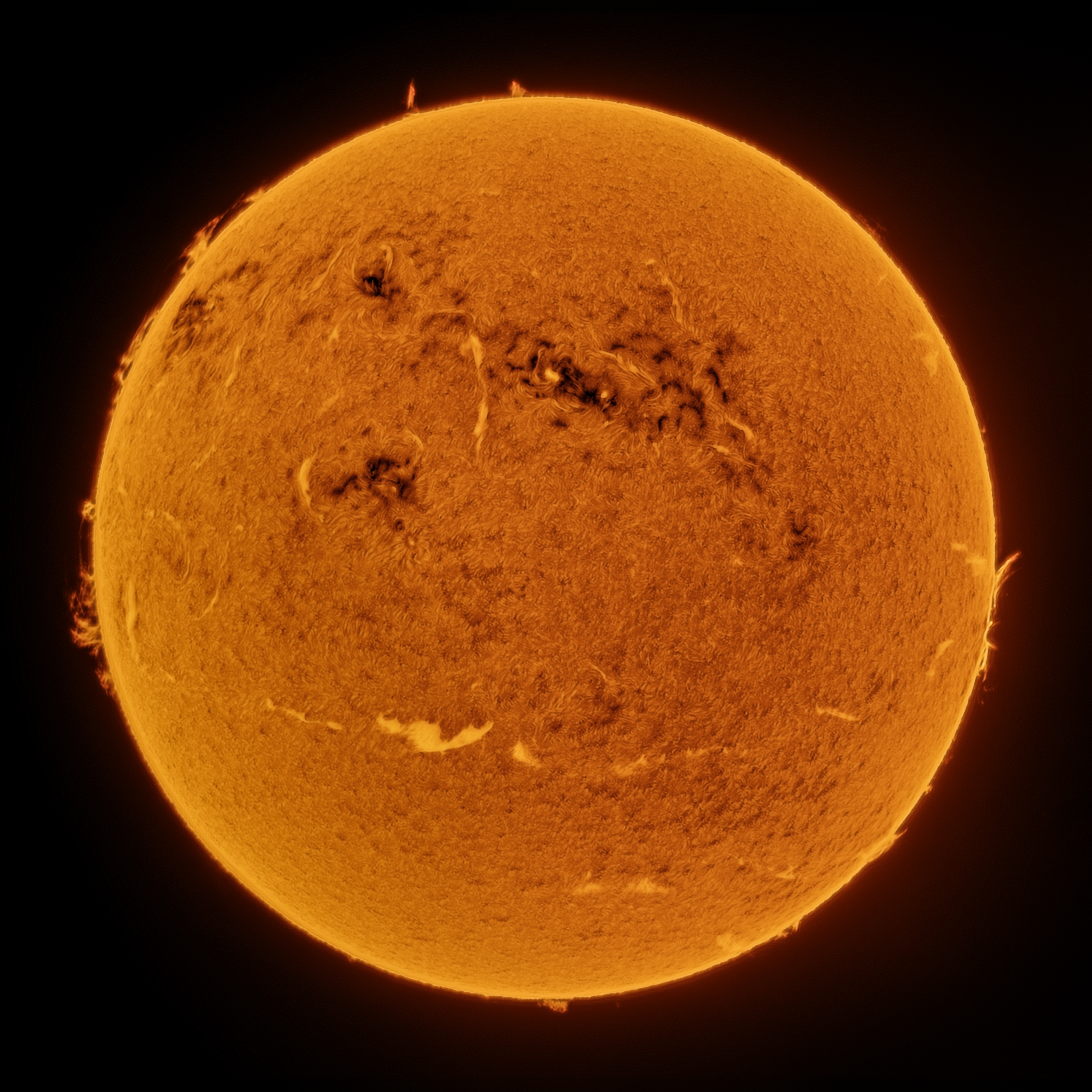
The Sun on 25 April 2026. Captured with the Acuter 40/400