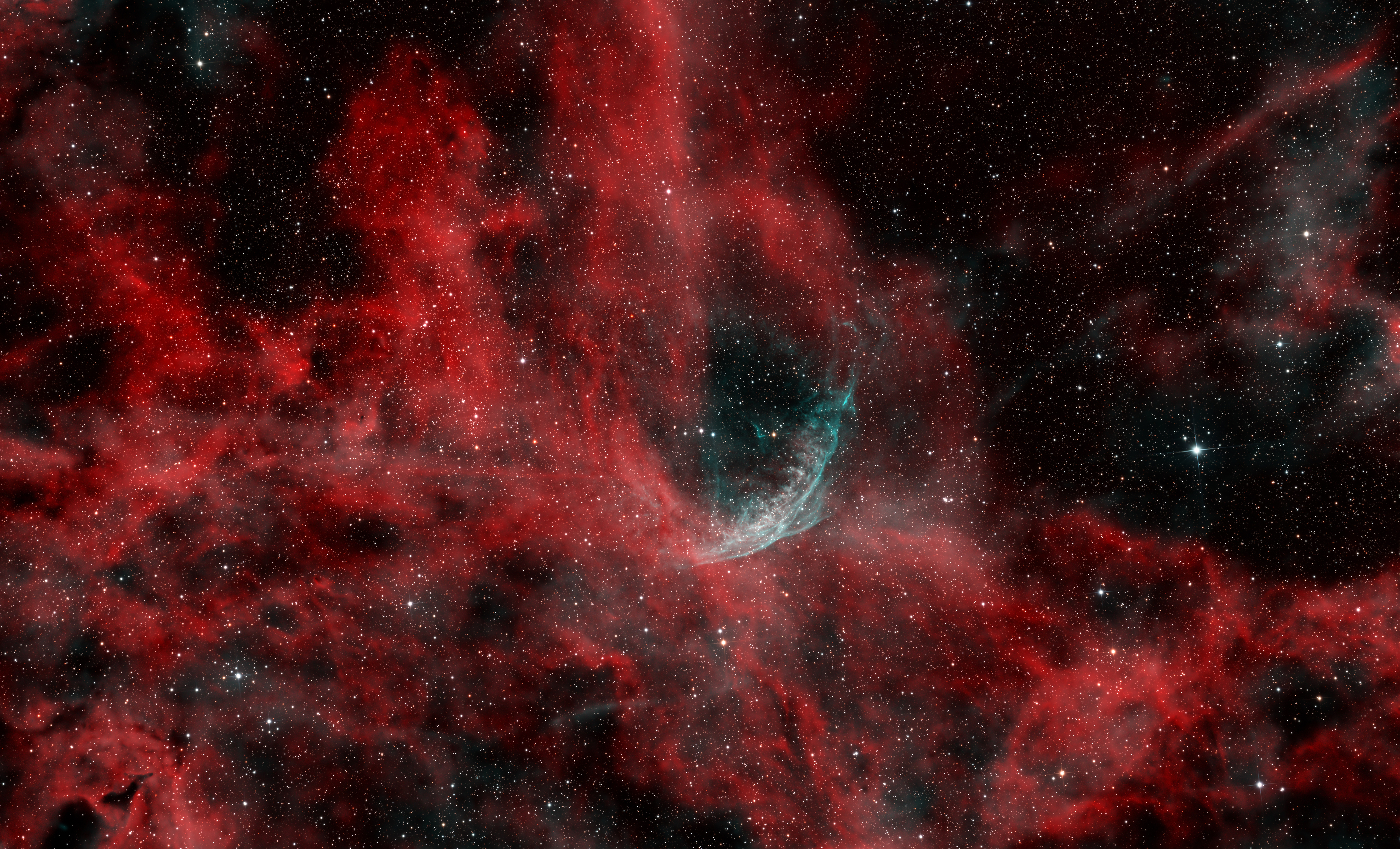
WR 134 is one of those targets where a single exposure initially reveals very little that looks spectacular. Surrounding the star is a very faint bubble of ionized gas, the most distinctive part of which is visible only as a delicate arc. Accordingly, this image required quite a bit of patience: in the end, I collected around 35 hours of exposure time over six nights.
WR 134 is located about 6,000 light-years away in the constellation Cygnus. It is a Wolf-Rayet star of spectral type WN6, an extremely hot, highly evolved massive star that has already shed some of its outer layers. Its fast stellar winds collide with the surrounding material and form an extended bubble. Part of this structure is particularly visible in the light emitted by ionized oxygen, O III. In the image, this emission appears turquoise to blue-green. It stands out only faintly against the much stronger red H-alpha nebulae that extend across large parts of the region.
For the imaging, I used my 8-inch Newtonian telescope with a focal length of 1,000 millimeters, an astro-modified Nikon Z6, and an Antlia Triband RGB Ultra filter. Most individual exposures were five minutes at ISO 800. A few tests with longer exposures provided no noticeable benefit and only caused the brighter stars to become more saturated, so I eventually stayed with 300 seconds per exposure.
As expected, very little of the bubble was visible in the individual frames. Only after combining the data from all six nights did the faint arc slowly emerge from the background. Image processing proved time-consuming as well. After calibration and integration in PixInsight, I first corrected the background and colors before separating the stars from the nebula. I then extracted the H-alpha and O III components from the color data using DBExtract and processed them separately. The faint O III arc in particular required targeted contrast enhancement and dedicated masks before the two emission components could be recombined into a color image.
The color treatment is therefore not a strictly natural representation, but rather an interpretive rendering of the emission lines actually recorded: red for the dominant hydrogen emission and turquoise for the ionized oxygen.
Even after 35 hours of exposure time, the bubble around WR 134 does not immediately jump out. You have to look a little more closely. But that is precisely what makes this target particularly appealing to me.