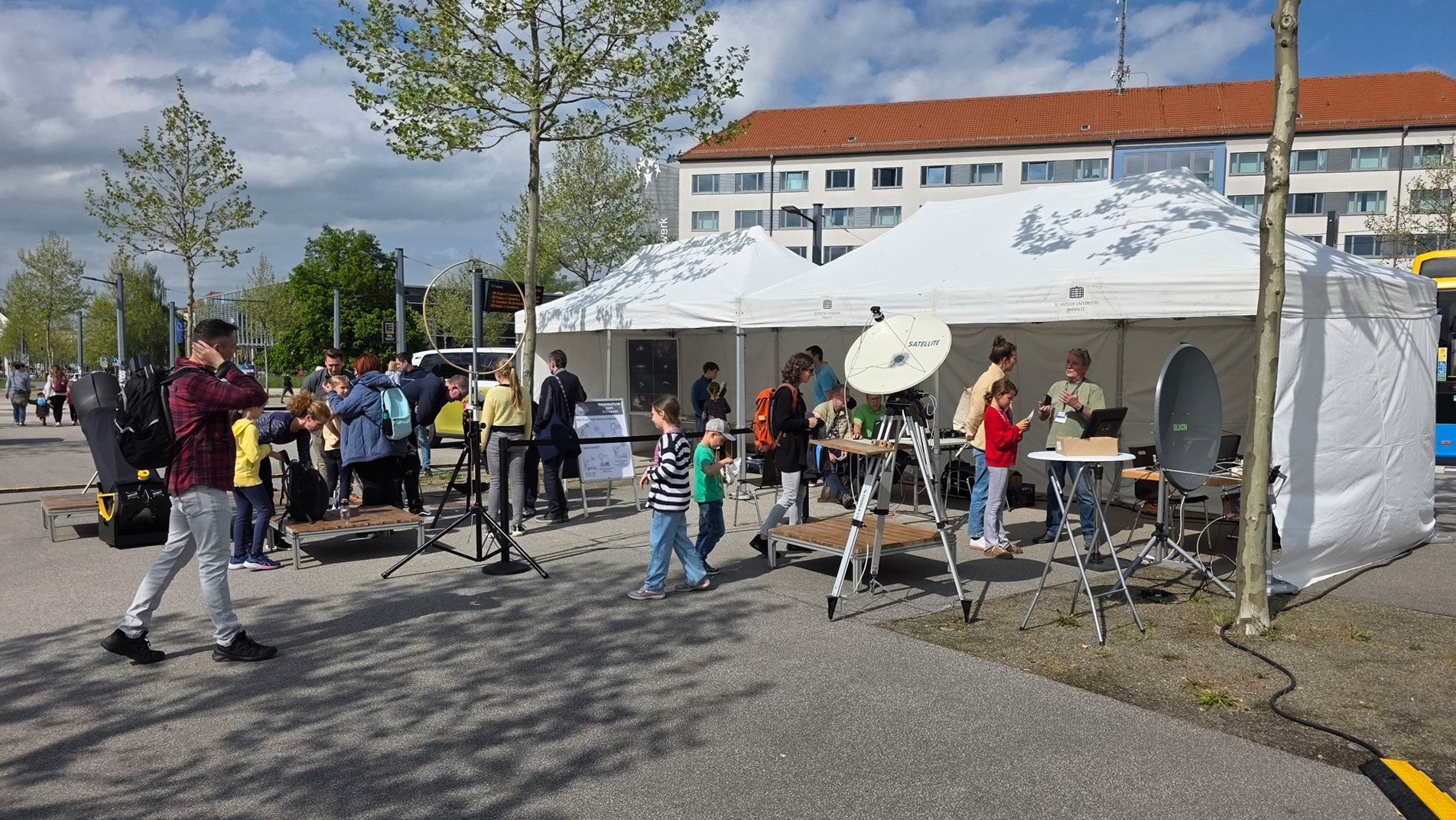
On 9 May 2026, we took part in TUCtag and the Long Night of Science on the campus square of Chemnitz University of Technology together with the Astro-Stammtisch Chemnitz. The Chemnitz amateur radio operators were also there, which meant that our stand was not only visually well equipped, but also quite impressive from a radio technology point of view.
In the afternoon, the Sun was the main focus. With two H-alpha telescopes, we were able to show our central star in the light of hydrogen. That is quite different from the usual “bright disk in the sky”. Suddenly, structures in the solar atmosphere become visible, prominences appear at the edge, and, depending on solar activity, there is also quite a bit of dynamics to see on the surface. That is exactly why I like this kind of observing: you are not simply looking at the Sun, but you get at least a small impression that there really is a rather unsettled fusion reactor up there.
Right next to us, the amateur radio operators showed that the sky can be explored not only with telescopes. Among other things, they presented radio technology for the geostationary satellite QO-100, a setup for receiving solar noise in the X band, and digital shortwave communication using FT8. I find this combination of astronomy and radio technology quite appealing, because both fields pursue the same goal in very different ways: making signals from far away visible, audible, or at least somehow tangible.
To be honest, the level of interest surprised us quite a bit. Many visitors stopped by our stand already in the afternoon, asked questions, and some even came back later. What I found especially nice was that a quick look through the telescope often turned into longer conversations: about the Sun, filter technology, planets, astrophotography, and of course the question why the view through an eyepiece usually does not look like the spectacular images from the internet. Spoiler: because astrophotography consists in roughly equal parts of technology, patience, weather frustration, and subsequent swearing at the computer.
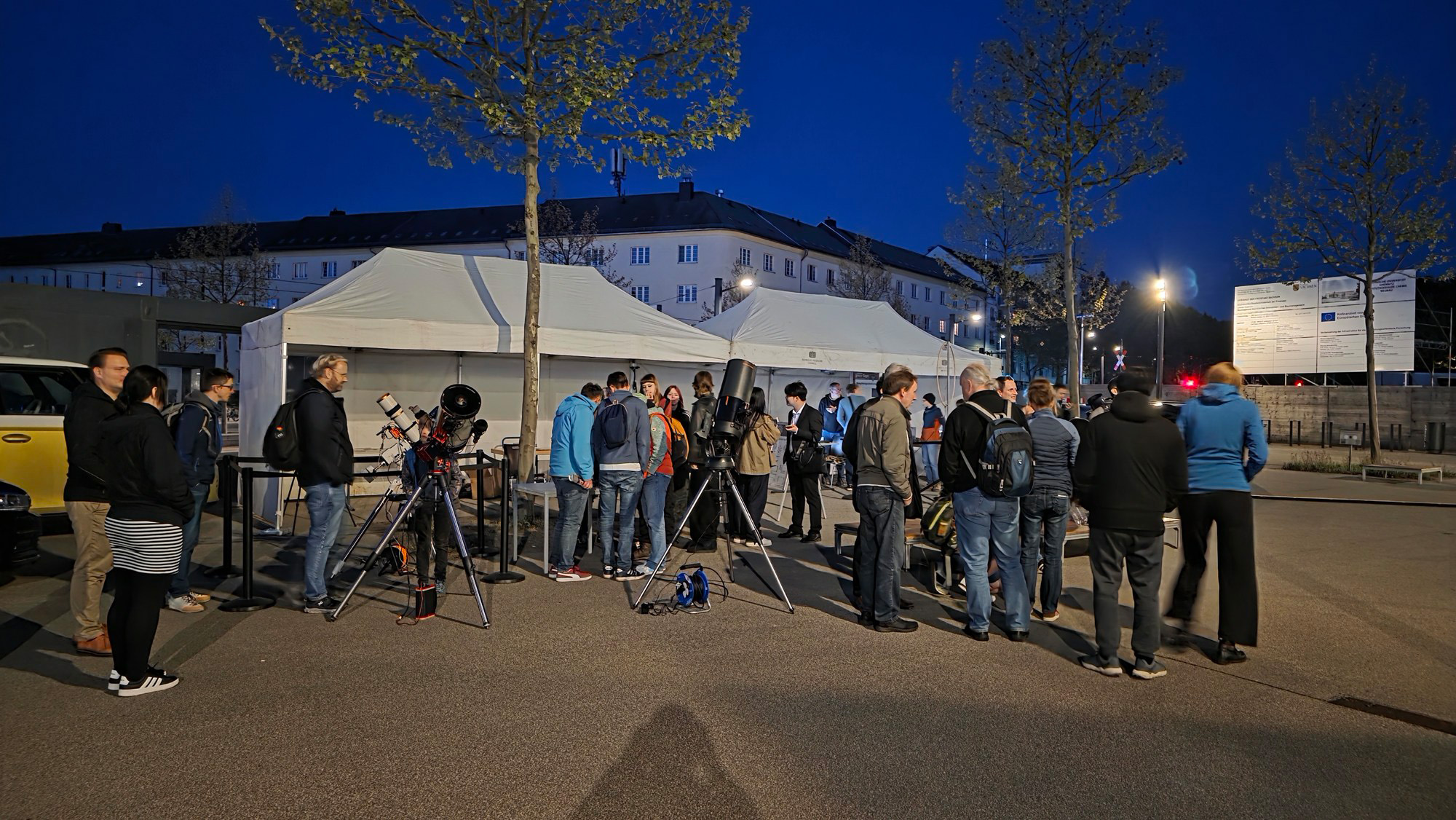
In the evening, TUC Tag then moved seamlessly into the Long Night of Science. Once it had become darker, we pointed the telescopes at Jupiter and later also at selected deep-sky objects. Among other instruments, Dobsonian and Schmidt-Cassegrain telescopes were used. Jupiter in particular is a grateful target for events like this, because even without much explanation you immediately recognise: this really is a planet. Not a screenshot, not a symbolic image, not a NASA poster, but real light that is passing through the telescope at that very moment. Another highlight was the talk “Journey to the Stars” by our Astro-Stammtisch member Frank at 10 p.m. The talk was very well attended and offered a nice arc from objects that can be seen with the naked eye or simple telescopes to some of the bigger questions in astronomy.
For me, the day was a nice confirmation that astronomy simply works as an outreach topic. It does not take much to spark curiosity: a telescope, a reasonably clear sky, a few visible structures on the Sun, or a small Jupiter in the eyepiece are often enough. And when antennas, satellite radio, and solar noise are added right next to it, the mix is almost perfect.
Many thanks to Chemnitz University of Technology for the opportunity to be part of TUCtag and the Long Night of Science, to the Chemnitz amateur radio operators for the great collaboration, and of course to all visitors who stopped by, asked questions, were amazed, and looked up into the sky with us.