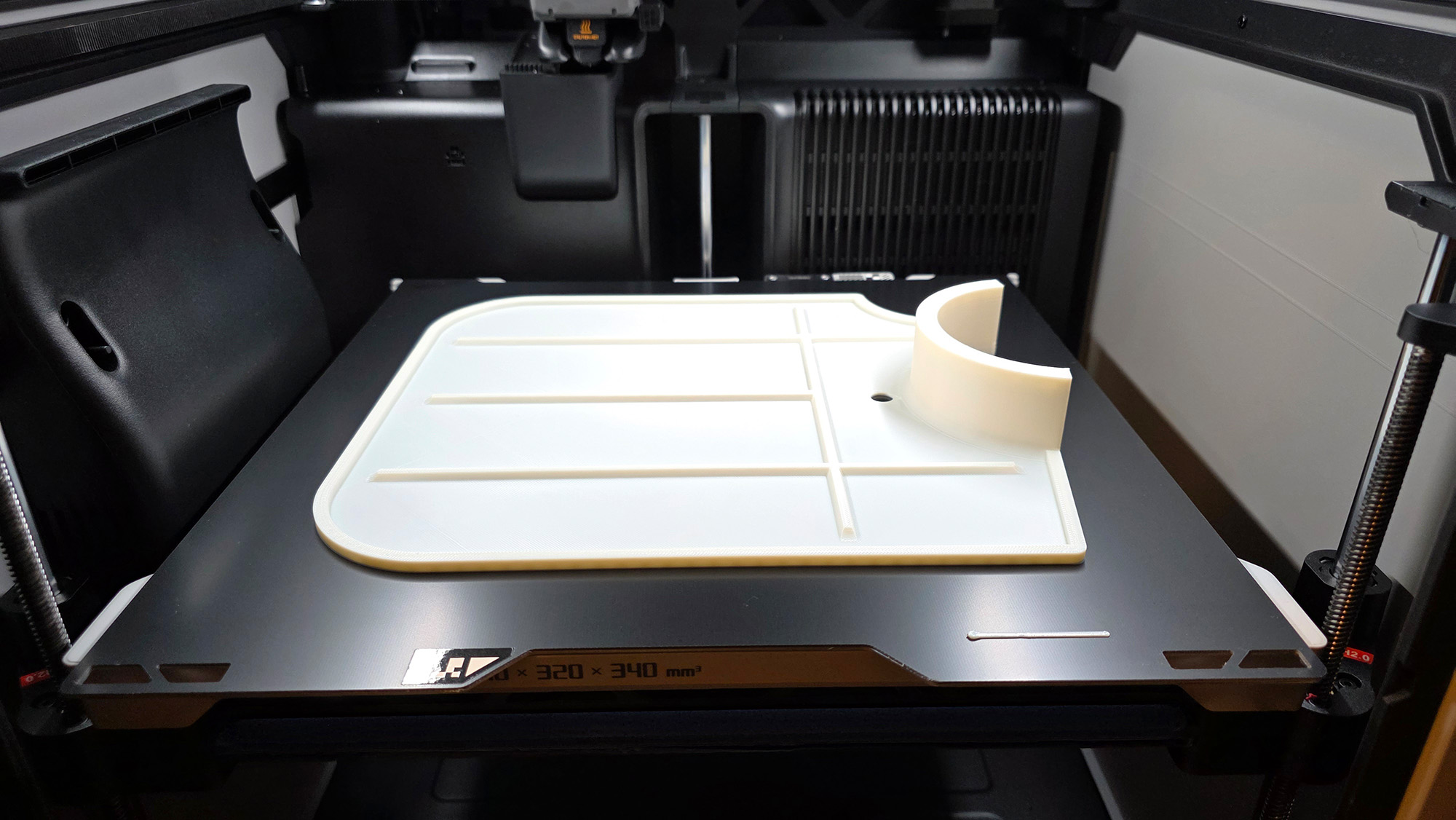
Warping-free printing of gigantic parts
Some time ago, I bought a Bambu Lab H2S. The main reason was its significantly larger build volume: while my Prusa i3 MK3S is limited to 250 × 210 × 210 millimeters, the H2S offers 340 × 320 × 340 millimeters. This finally allows me to print parts that I previously had to split into several pieces or abandon altogether.
The H2S comes with a Textured PEI Plate. It is quite versatile and is suitable not only for everyday filaments such as PLA and PETG, but also for TPU and various high-temperature materials. For ASA and some other engineering filaments, however, Bambu recommends using a glue stick or at least notes that an additional adhesion aid or release layer may be necessary. That is not a major problem in itself. However, I had little desire to keep coating my build plate with consumable adhesive. I therefore started looking for a separate plate for ASA and other more demanding filaments that would work without any additional adhesion aids.
During my research, I repeatedly came across G10, often also referred to as Garolite. It is a stiff and dimensionally stable laminate made from woven fiberglass and epoxy resin. Eventually, I found IDE 3D, a German supplier offering a suitable G10 build plate for the Bambu Lab H2S.
I have been extremely pleased with the plate so far. Since I only stumbled across the shop by chance, I thought I would write a short report about it here. With ASA, I regularly struggled with warping on my Prusa MK3S, even inside my homemade IKEA enclosure. On the H2S, by contrast, the material sticks perfectly to the G10 plate without any glue stick. After printing and a short cooling period, the part can still be removed easily.
Of course, comparing the two printers is not entirely fair. The H2S has an actively heated build chamber and therefore provides much more controlled thermal conditions than my previous DIY enclosure. The G10 plate is certainly not the only reason for the improved results. In combination with the H2S, however, it performs exactly as I had hoped: reliable adhesion during printing, easy removal afterward, and, above all, no more constantly messing around with a Pritt glue stick.
For PLA and PETG, I can continue using the supplied PEI plate. For ASA and other engineering filaments, I now have my separate G10 plate. And the glue stick can stay in the drawer for the time being.