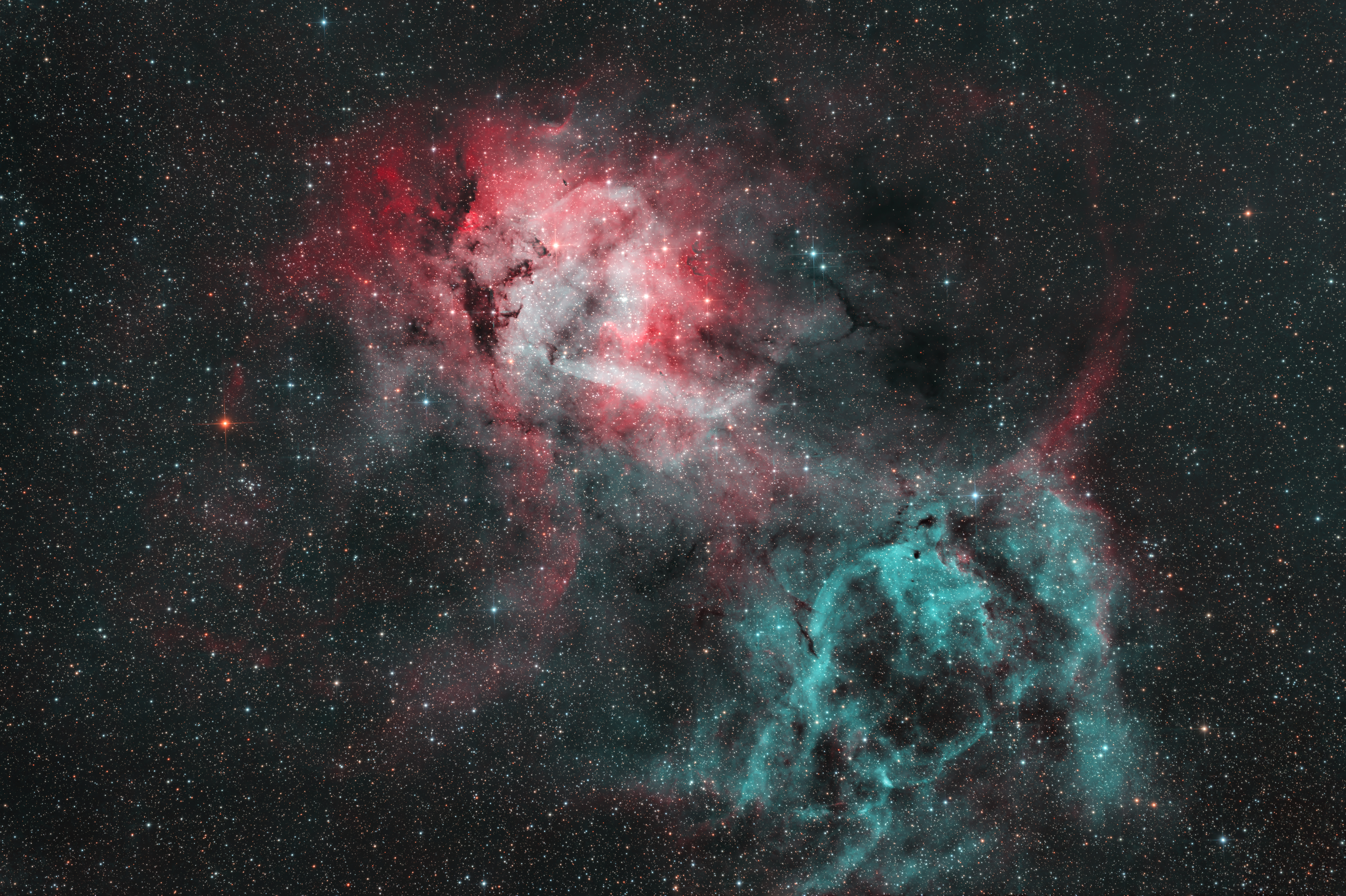
The Lion Nebula, Sh2-132, showing bright hydrogen regions and fainter O III structures
Over the course of two consecutive nights, I pointed my telescope at Sh2-132, the Lion Nebula in the constellation Cepheus. This extended H II region lies close to the border with Lacerta and is shaped by several massive stars. Their intense radiation and stellar winds ionize the surrounding gas and form the nebula’s glowing structures.
In images, the hydrogen emission tends to dominate, while the considerably fainter O III signal prefers to keep a low profile. This time, however, conditions were favorable: the Moon was only eight percent illuminated and contributed very little unwanted light during either night. Combined with the exposure time accumulated over both nights, this was enough to reveal a surprising amount of the faint oxygen signal. That was a particularly pleasant surprise when processing the data. Between the stronger hydrogen regions, the finer O III structures also emerge and give the nebula additional depth. Whether it really resembles a lion is – as with many astronomical object names – a matter of imagination. But that is part of the fun.